Zagrun logo
Marketing & Growth2026-10-27T20:54:51+00:00
Reach the Right People. Create Real Opportunities.

Marketing & Growth

Great businesses don’t grow simply because they exist. We develop practical marketing strategies that help you reach the right audience, build awareness, generate qualified leads, strengthen customer relationships, and turn opportunities into measurable business growth.
  • WEBSITES, EXPLAINED

Your Business Needs More Than a Great Website.

Building a recognizable brand and a professional website establishes a strong foundation. But neither guarantees that customers will discover your business, understand your value, or choose you over the competition.

Marketing connects the dots. It puts your business in front of potential customers, gives them reasons to pay attention, and encourages them to take the next step. We help you find the right combination of strategies to attract customers and keep your business moving forward.

Nine Building Blocks of Smarter Marketing.

There’s no shortage of ways to market a business. The challenge is knowing which opportunities are worth pursuing, how they work together, and where your time and money will make the greatest impact.

Marketing Strategy, Research & Competitive Analysis

Before spending money on marketing, it’s important to understand your market. Who are your ideal customers? What are they looking for? Where do they spend their time? How do they choose between competing businesses?

We research your audience, study your competitors, evaluate market opportunities, and assess your current marketing efforts. From there, we help establish realistic objectives, define your messaging, prioritize marketing channels, and develop a practical plan with budgets and measurable goals.

This can include market research, competitor reviews, customer personas, audience segmentation, campaign planning, marketing audits, positioning, and go-to-market strategies.

WHY IT MATTERS:
Good research helps prevent expensive mistakes. A thoughtful strategy gives your marketing direction, reduces unnecessary spending, and helps you focus on the customers and opportunities most likely to benefit your business..

Advanced SEO & Search Visibility

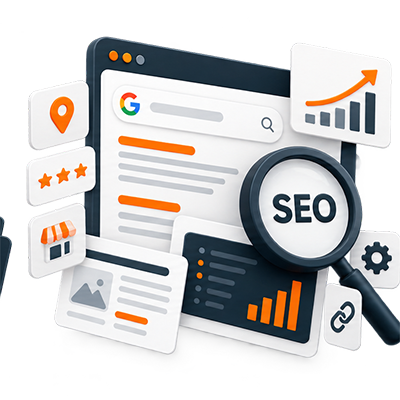
Being online doesn’t automatically mean being found. Search engine optimization (SEO) is the ongoing process of improving your visibility when potential customers search for products, services, and solutions like yours.

Beyond the foundational SEO incorporated into website development, we work on deeper keyword and competitor research, content optimization, local SEO, Google Business Profile optimization, business listings, relevant backlink opportunities, internal linking, structured data, and technical improvements.

We also monitor how search behavior is evolving across traditional search engines, map listings, and AI-powered discovery tools.

WHY IT MATTERS:
Search visibility can connect your business with customers who are actively looking for what you offer. Unlike a one-time website launch, successful SEO often requires continued research, fresh content, technical improvements, and competitive attention.

Paid Advertising & Retargeting

Paid advertising allows you to put your business in front of targeted audiences through search engines, social media, websites, and other advertising platforms.

We plan and manage campaigns across platforms such as Google Ads, Microsoft Advertising, Facebook, Instagram, and LinkedIn, depending on your audience and goals. Services can include paid search, display advertising, paid social campaigns, audience targeting, retargeting, ad creative, landing pages, conversion tracking, and ongoing campaign optimization.

Retargeting is especially useful for reconnecting with people who have already visited your website or interacted with your business but haven’t yet taken action.

WHY IT MATTERS:
Paid advertising can generate visibility much faster than many organic strategies, but it’s also easy to waste money when targeting, messaging, landing pages, or tracking aren’t properly planned. Careful management helps turn an advertising budget into a measurable business investment.

Content, Blogging & Video Marketing

People rarely make purchasing decisions without first learning something about a business. Useful content helps answer their questions, demonstrate your expertise, and give them reasons to trust you.

We develop blogs, articles, guides, case studies, newsletters, website content, educational resources, photography, graphics, and multimedia campaigns.

We also help plan, produce, edit, and publish marketing videos, including company introductions, product demonstrations, customer testimonials, educational videos, promotional clips, webinars, and short-form social content.

Content can be developed for your website, YouTube, social media, email campaigns, advertising, and other channels.

WHY IT MATTERS:
Strong content works across multiple marketing efforts. A helpful article might support search visibility, become several social posts, inspire an email campaign, and provide talking points for a video—all while helping customers understand your value.

Social Media, Influencer & Affiliate Marketing

Social media gives businesses opportunities to communicate directly with their audiences, share useful information, promote offers, and build ongoing relationships.

We help develop social media strategies, content calendars, graphics, posts, community engagement programs, and campaigns tailored to platforms such as Facebook, Instagram, LinkedIn, YouTube, and others where your audience is active.

When appropriate, we can also explore influencer partnerships, brand ambassadors, affiliate programs, referral incentives, and collaborative campaigns with complementary businesses.

WHY IT MATTERS:
Social media isn’t just about collecting followers. It’s about building familiarity, encouraging engagement, strengthening customer relationships, and creating opportunities for discovery. The right audience matters much more than the biggest audience.

Email, SMS, CRM & Marketing Automation

Not every potential customer is ready to buy today. And once someone becomes a customer, you shouldn’t have to start building that relationship from scratch.

We help businesses communicate with prospects and customers through email newsletters, promotional campaigns, automated follow-ups, customer reminders, segmented messaging, and permission-based text marketing.

We also work with customer relationship management (CRM) and marketing automation systems to organize contacts, track opportunities, manage sales pipelines, and automate repetitive communication. Depending on your needs, this may involve platforms such as Mailchimp, HubSpot, Salesforce, or other compatible tools.

WHY IT MATTERS:
Consistent follow-up can be the difference between a missed opportunity and a new customer. Organized customer information and thoughtful automation help you maintain relationships, reduce manual work, and stay in contact without overwhelming your audience.

Public Relations, Events & Strategic Partnerships

Sometimes the best marketing opportunities happen outside your own website and advertising accounts.

We help businesses develop public relations efforts, announcements, media materials, press releases, community outreach, sponsorships, and relationships with relevant organizations.

We can also support trade shows, corporate events, conferences, product launches, networking events, community activities, and other experiences that put your business directly in front of potential customers.

For businesses facing sensitive public communications, we can help coordinate an appropriate messaging and response strategy, including specialized professional support when needed.

WHY IT MATTERS:
Credibility often grows when people hear about your business from sources beyond your own marketing. Positive media coverage, trusted partnerships, community involvement, and memorable events can help build awareness and strengthen your reputation.

Promotions, Print & Direct Marketing

Not every effective marketing tactic happens on a screen. Traditional marketing and promotional campaigns still have an important place, particularly for local businesses, retailers, restaurants, and organizations reaching specific communities.

We develop brochures, flyers, catalogs, postcards, direct mail campaigns, signage, promotional merchandise, branded giveaways, coupons, special offers, contests, raffles, loyalty initiatives, referral promotions, and other campaign materials.

We can help coordinate both the creative and logistical considerations, from messaging and graphic design to vendors, production, distribution, and campaign timing.

WHY IT MATTERS:
The right promotion can create urgency, encourage repeat business, reward loyal customers, or introduce your brand to a new audience. When coordinated with your digital marketing, even traditional materials become part of a larger, more effective strategy.

Analytics, Testing & Conversion Optimization

Marketing is only valuable when it contributes to meaningful business goals. That’s why measuring performance is as important as launching a campaign.

We help establish appropriate tracking, reporting, and measurement through tools such as Google Analytics 4, Google Search Console, advertising dashboards, CRM reporting, and conversion tracking systems.

We evaluate visitor behavior, campaign performance, leads, customer acquisition costs, and other important metrics. We also identify opportunities to improve landing pages, calls to action, forms, offers, advertising creative, and the steps customers take before contacting or purchasing from you.

When appropriate, we use testing and comparison to better understand what works.

WHY IT MATTERS:
Without measurement, it’s difficult to know whether your marketing budget is producing results. Good analytics helps us make informed decisions, identify opportunities, stop wasting money on underperforming tactics, and continually improve the effectiveness of your marketing.

Not Sure Where to Start With Your Marketing?

You don’t need to understand every marketing platform or tactic. Tell us what you’re trying to accomplish, and we’ll help you identify the opportunities worth exploring.

  • STRAIGHTFORWARD ADVICE

You Don’t Need Every Marketing Tactic. You Need the Right Ones.

There’s no universal marketing formula that works for every business.

A neighborhood restaurant, a regional construction company, an ecommerce retailer, and a nationwide software provider may all want more customers, but the strategies required to reach them can be completely different.

Their audiences are different. Their competitors are different. Their buying cycles, budgets, geographic markets, and customer expectations are different.

That’s why we don’t believe in recommending the same combination of advertising, social media, SEO, and email campaigns to every client.

Do the Homework Before Spending the Money.

Imagine deciding to spend $5,000 on advertising tomorrow. We could probably have ads running fairly quickly. But should we?

Before committing that money, we’d want to understand who you’re targeting, what you’re offering, how competitive your market is, which platforms make sense, and what happens after someone clicks your advertisement.

Does your website clearly communicate your value? Is there a compelling reason to contact you? Do you have reliable tracking? Can your business respond to new inquiries? Can you afford the cost of acquiring a new customer? Without those answers, even a well-designed advertisement can become an expensive lesson.

  • STRAIGHTFORWARD ADVICE

Marketing Takes Commitment.

Some marketing efforts can produce results relatively quickly. Others take months of consistent work before their full value becomes clear.

Search visibility develops over time. Content needs to be created and distributed. Advertising campaigns require testing and refinement. Customer relationships need ongoing attention.

And sometimes an approach that looked promising doesn’t work as expected. When that happens, the right response isn’t to keep spending blindly. It’s to understand why, adjust the strategy, and make better decisions.

We won’t promise overnight success or suggest that every dollar spent on marketing will automatically produce a return.

Our goal is to build marketing programs that are practical, measurable, and capable of becoming more effective over time.

  • STRAIGHTFORWARD ADVICE

Effective Marketing Doesn’t Have to Be Manipulative.

Let’s address something else: not everyone likes being marketed to.

Popups, promotional emails, online advertisements, retargeting campaigns, and text reminders can sometimes feel intrusive. Yet when they’re used thoughtfully, many of these tactics can also be effective.

The difference is how they’re implemented.

A timely reminder about an abandoned shopping cart can be helpful. Ten messages about the same product in one afternoon probably aren’t. A relevant special offer can encourage someone to buy. A misleading countdown timer or fabricated discount undermines trust.

We believe in persuasive marketing—not deceptive marketing.

We’ll use attention-grabbing creative, intelligent timing, relevant offers, segmentation, and other proven techniques to encourage action. But we won’t intentionally mislead customers, manufacture false claims, misuse personal information, or damage your reputation for a short-term result.

Good marketing should make it easier for customers to choose you—not trick them into doing so.

  • WHAT’S CHANGING

More Technology. More Competition. Less Attention.

Marketing has never offered businesses more ways to reach potential customers. Unfortunately, those same opportunities are available to everyone else.

Artificial intelligence makes it faster to develop content and advertising. Automation makes it easier to communicate with customers. Advertising platforms offer increasingly sophisticated targeting and optimization tools.

But these advances also create challenges.

Your customers are exposed to enormous amounts of content and advertising. They have more choices, more information, and more opportunities to ignore anything that doesn’t interest them.

AI Is Changing the Tools, Not the Fundamentals.

AI can help marketers research ideas, analyze data, develop content, create variations of advertisements, and improve workflows. Used appropriately, it can save time and make certain marketing activities more efficient.

But generating more content isn’t necessarily the same as creating better marketing.

Businesses still need a clear identity, a compelling message, accurate information, useful creative work, and a genuine understanding of their customers.

AI-generated material that sounds like everyone else’s marketing may do little to help a business stand out.

  • WHAT’S CHANGING

Privacy and Trust Are Becoming More Important.

Customers are also more aware of how businesses collect and use their information. Changes in tracking technology, privacy expectations, platform policies, and data regulations make it increasingly important to develop responsible, permission-based customer relationships.

Building your own email list, maintaining accurate customer records, collecting meaningful first-party data, and delivering relevant communications can be valuable parts of a long-term strategy.

  • WHAT’S CHANGING

The Future Belongs to Businesses That Stay Relevant.

The most effective marketing isn’t necessarily the loudest, most expensive, or most technologically sophisticated.

It’s the marketing that understands its audience, communicates genuine value, earns trust, and adapts as customer behavior changes.

At Zagrun, we keep an eye on evolving tools and trends while staying focused on what matters: helping your business connect with the right customers and turn those connections into opportunities.

Marketing FAQs

Can Zagrun help with traditional marketing, events, public relations, and offline campaigns?2026-10-27T18:33:25+00:00

Yes. Marketing doesn’t begin and end with digital advertising.

Depending on your goals, we can help develop print materials, brochures, flyers, postcards, catalogs, direct mail campaigns, signage, promotional merchandise, coupons, special offers, contests, and customer loyalty initiatives.

We can also assist with promotional messaging, marketing creative, event materials, trade show graphics, sponsorship campaigns, press releases, media outreach materials, and other business communications.

For specialized needs—such as complex media relations, crisis communications, legal requirements for promotions, or large-scale event production—we can help define the scope and coordinate appropriate expertise when needed.

What matters is how these activities support your overall strategy.

A postcard may lead someone to a special landing page. A trade show can generate contacts for an email follow-up sequence. A promotional product can reinforce your brand long after an event ends.

The best marketing plans don’t separate digital and traditional tactics just for the sake of it. They connect the opportunities that make sense for your business.

Do I need to commit to an ongoing marketing program, or can Zagrun help with individual projects?2026-10-27T18:33:08+00:00

Both approaches can make sense.

Some businesses need a defined project, such as developing a marketing strategy, producing a promotional video, creating a direct mail campaign, launching an email program, or preparing materials for an event.

Others benefit from ongoing support for content production, SEO, paid advertising, social media, email marketing, analytics, or campaign optimization.

We can discuss fixed-scope projects, ongoing monthly services, or a combination of the two, depending on the work involved.

Certain services naturally require continued attention. Advertising campaigns need monitoring, CRM systems need maintenance, SEO benefits from ongoing improvements, and customer communications require fresh content.

That doesn’t mean every business needs an expensive monthly marketing agreement.

We’ll help identify what can be accomplished as a one-time project, which activities require recurring support, and what responsibilities your team can reasonably manage.

The scope, deliverables, schedule, fees, and any ongoing commitments will be defined before work begins.

What happens if a marketing campaign isn’t working?2026-10-27T18:40:17+00:00

We investigate before making assumptions.

An underperforming campaign might have the wrong audience, an uncompetitive offer, ineffective creative, an unclear message, an inadequate landing page, tracking problems, or a follow-up process that fails to convert inquiries.

Sometimes the market is simply more competitive or expensive than expected.

The right response depends on the cause.

We may adjust targeting, revise advertisements, test different offers, improve landing pages, refine conversion tracking, or recommend reallocating the budget.

In some cases, the best recommendation is to pause or discontinue a campaign rather than continue spending money on an approach that isn’t producing acceptable results.

We also distinguish between campaigns that genuinely aren’t working and strategies that haven’t had sufficient time or data to evaluate properly.

Our responsibility is to help you understand what the results are telling us and make better decisions with your marketing investment.

Not every campaign will be successful. What matters is how intelligently we respond.

How will I know whether my marketing is actually working?2026-10-27T18:39:58+00:00

We begin by identifying what success means for your business.

For some companies, the objective is generating qualified leads. For others, it’s increasing online sales, booking appointments, filling event registrations, encouraging repeat purchases, or expanding into a new market.

Once we understand the goal, we can identify the most useful ways to measure progress.

Depending on the campaign, we may track website visitors, conversion rates, inquiries, cost per lead, customer acquisition costs, advertising performance, sales revenue, repeat purchases, and customer retention.

We also look beyond surface-level numbers.

Thousands of website visits or social media impressions might look impressive, but they mean little if they aren’t reaching potential customers or contributing to business goals.

Return on investment (ROI) is especially important, but measuring it isn’t always simple. Marketing campaigns can influence customers across several interactions before a sale happens. Revenue also isn’t the same as profit.

We’ll work to establish practical reporting and reasonable attribution methods so you can understand what’s happening, what can be measured reliably, and where uncertainty remains.

The purpose of reporting isn’t to overwhelm you with charts. It’s to help you make informed business decisions.

What’s the difference between email marketing, a CRM, and marketing automation?2026-10-27T18:32:11+00:00

These services are closely related, but they accomplish different things.

Email marketing involves communicating with groups of customers or prospects through newsletters, announcements, promotions, educational messages, and other campaigns.

A customer relationship management system (CRM) organizes information about your contacts, prospects, customers, and business opportunities. It can help your team manage relationships, record interactions, and track the progress of potential sales.

Marketing automation uses defined rules and triggers to deliver communications or perform tasks automatically.

For example, someone might request a guide from your website. The CRM records the inquiry, an automated email delivers the guide, another message follows up several days later, and your sales team receives a notification if the person requests a consultation.

These systems can become quite sophisticated, but they don’t have to be.

For a small business, even a simple automated welcome message, follow-up reminder, or customer reactivation campaign can provide meaningful value.

We help you determine what level of technology and automation makes sense for your needs, budget, and ability to manage it.

The goal is to improve customer relationships and reduce repetitive work—not add unnecessary complexity.

Aren’t popups, retargeting ads, promotional emails, and text messages annoying? Do they actually work?2026-10-27T18:31:43+00:00

They certainly can be annoying. Anyone who spends time online has encountered marketing that’s too aggressive, repetitive, or poorly timed.

But these tactics continue to be used because, under the right circumstances, they can encourage useful actions.

A customer who left items in an online shopping cart may appreciate a reminder. Someone who requested information about your services may welcome a helpful follow-up email. An existing customer may want to know about a seasonal promotion or limited-time offer.

Retargeting advertisements can also help keep your business visible to people who have previously shown interest but weren’t ready to make a decision.

However, effective marketing and excessive marketing are not the same thing.

We consider relevance, timing, frequency, consent, and the customer experience when recommending these tactics.

We don’t believe in misleading claims, deceptive interfaces, fabricated urgency, purchased lists used for unsolicited messages, or tactics that intentionally exploit customers.

We also respect applicable privacy, email, text messaging, and advertising requirements.

Our objective is to make communications timely, useful, and persuasive enough to encourage action—without creating unnecessary frustration or harming your reputation.

Do I need to advertise on Google, post on every social network, send emails, and create videos?2026-10-27T18:31:20+00:00

Absolutely not.

Different marketing channels serve different purposes, and not all of them are appropriate for every business.

A local emergency plumbing company may benefit from reaching customers who are actively searching for immediate help. A boutique retailer might find that visual social content, email promotions, and seasonal events are especially useful.

A B2B software company may place more emphasis on educational content, professional networks, webinars, and a longer lead-nurturing process.

Trying to be active everywhere can spread a limited budget and your attention too thin.

We’d rather help you establish a strong presence in the channels most relevant to your customers than encourage you to maintain a dozen accounts or campaigns that accomplish very little.

As your business grows, we can evaluate whether adding new marketing channels makes sense.

More marketing activity doesn’t automatically mean better marketing.

Isn’t SEO already included when you build my website? Why would I pay for more?2026-10-27T18:30:59+00:00

Foundational SEO is an important part of professional website development, and we incorporate appropriate SEO considerations into our website projects.

This can include page structure, titles, descriptions, navigation, mobile usability, crawlability, internal linking, and other technical and content fundamentals defined in the project scope.

But a search-friendly website and an ongoing competitive SEO campaign are not the same thing.

Advanced SEO may involve extensive keyword research, competitor analysis, development of new pages and helpful resources, ongoing content optimization, local search improvements, reputation management, relevant backlink development, and regular analysis of search performance.

In competitive markets, businesses often need to demonstrate greater relevance, usefulness, credibility, and depth than competing websites.

And because competitors continue investing in their own visibility, SEO isn’t necessarily a project that ends once you reach a particular position.

Website SEO establishes the foundation. Advanced SEO works to improve your ability to compete.

We’ll help you understand what your website already includes and whether additional SEO services are likely to be worthwhile.

I already have a professional website. Why isn’t it generating more business?2026-10-27T18:30:40+00:00

Because having a website and attracting customers to that website are two different challenges.

A well-built website gives your business a professional place to explain its services, establish credibility, and encourage visitors to take action.

But first, people need to know it exists.

Think about opening a beautiful new retail store on a street where nobody ever walks. The interior might be impressive, the products excellent, and the staff ready to help. But without traffic, the business will struggle to generate sales.

A website can face the same problem.

That’s why we encourage clients to think about their digital presence as three connected investments:

BRAND → WEBSITE → MARKETING

Your brand establishes who you are and why customers should trust you.

Your website communicates that value and provides the tools for customers to engage with your business.

Your marketing creates opportunities for the right people to discover your business and visit your website.

Even then, results depend on your offer, competition, pricing, reputation, and ability to convert inquiries into customers.

Launching a website gets your business online. Marketing helps bring your business to market.

How long does it take for marketing to produce results?2026-10-27T18:30:10+00:00

It depends on the strategy, your starting position, and the market you’re competing in.

Some paid advertising campaigns can begin generating traffic and inquiries shortly after launch. However, getting clicks isn’t the same as producing profitable customers. Targeting, creative, bidding, and landing pages often require testing and refinement.

Advanced SEO and content marketing typically take longer. Building search visibility in a competitive industry may involve months of ongoing improvements and content development.

Email marketing to an established, engaged customer list may produce responses relatively quickly. Building that list and developing effective automation can take much longer.

Brand awareness, public relations, social media engagement, and reputation building may influence customers over an extended period rather than produce immediate sales.

We’ll work with you to establish reasonable milestones and appropriate ways to measure progress.

Marketing is rarely a switch you flip to make customers appear. It’s an ongoing effort to become more visible, relevant, persuasive, and competitive.

Some results arrive quickly. Others take patience. And no responsible marketer should promise a specific outcome before understanding the circumstances.

If I spend $5,000 on online advertising, how many new customers should I expect?2026-10-27T18:29:45+00:00

There’s no honest way to answer that question without knowing considerably more about your business, audience, competition, and campaign.

Advertising platforms often charge based on clicks, impressions, or other actions. Those costs can vary dramatically depending on the industry, location, audience, competition, and advertising format.

Consider a simplified example.

If your average advertising cost were $10 per click, a $5,000 budget could generate approximately 500 website visits.

If 5% of those visitors submitted an inquiry, that would result in about 25 leads.

But leads aren’t customers. Some may not be qualified, some may be comparing several companies, and others may never respond to follow-up communications.

We still need to know how many leads become paying customers, how much revenue they generate, and how profitable those sales are after accounting for advertising and other costs.

And those figures are only hypothetical. Actual costs and conversion rates could be much better or much worse.

This is why we establish tracking, research opportunities, evaluate landing pages, and often recommend controlled testing before committing to larger advertising budgets.

A campaign that generates 100 inexpensive but unqualified leads may be far less valuable than one that generates 10 strong opportunities.

We want to understand what your advertising is producing—not simply how many people clicked on it.

Are advertising costs included in Zagrun’s fees?2026-10-27T18:28:38+00:00

Generally, no. Advertising spend and Zagrun’s professional fees are separate expenses.

When you advertise through platforms such as Google Ads, Facebook, Instagram, or LinkedIn, the advertising platform charges for delivering your advertisements. That money is commonly called ad spend or media spend.

Zagrun’s fees cover the professional services involved in researching, planning, creating, configuring, managing, monitoring, and optimizing those campaigns, as defined in your agreement.

For example, if we agree on a $2,000 monthly advertising budget, that represents money allocated to the advertising platform. It doesn’t automatically include Zagrun’s campaign management fee, creative production, landing page development, or other services.

Advertising is also typically an ongoing expense. The platform continues charging as your advertisements run, subject to your budgets and campaign settings.

We prefer keeping these costs transparent so you understand exactly where your money is going.

An advertising budget should be treated as a business investment with specific objectives and measurable performance—not as a guaranteed purchase of customers.

How much does professional marketing cost?2026-10-27T17:39:09+00:00

Marketing costs vary widely because the work itself varies widely.

A monthly email newsletter requires a different level of effort than a comprehensive marketing program involving multiple advertising platforms, continuous content production, advanced SEO, video creation, and marketing automation.

At Zagrun, we generally separate marketing expenses into three areas:

Strategy & Setup: Initial research, audits, planning, campaign development, platform configuration, tracking, and other work needed to prepare a marketing initiative.

Ongoing Management & Production: The time and expertise required to operate campaigns, create content, manage platforms, monitor results, and make improvements. Depending on the scope, this may be structured as a monthly service agreement or a defined project.

Advertising & Third-Party Costs: Money paid to advertising platforms, software providers, printers, media outlets, production vendors, and other outside services.

We’ll explain the scope, costs, and expected responsibilities before work begins.

We’re also mindful that smaller businesses have limited budgets. Sometimes the right recommendation is to begin with one or two carefully selected activities and expand only when the results justify it.

The goal is not to spend the largest marketing budget possible. It’s to use the budget you have intelligently.

Why is market research and competitor analysis so important before launching a campaign?2026-10-27T17:38:15+00:00

Because spending money to reach the wrong audience—or delivering the wrong message to the right audience—can be remarkably expensive.

Market research helps us understand customer needs, buying behavior, geographic opportunities, industry trends, and the factors that influence purchasing decisions.

Competitor analysis helps reveal how other businesses position themselves, what they’re promoting, which audiences they appear to target, and where there may be opportunities to differentiate your business.

We also want to understand the economics of your business. What’s an average customer worth? How often do customers return? How long does it take to close a sale? How much can you reasonably afford to spend to acquire a new customer?

These answers influence everything from advertising budgets to promotional offers and campaign messaging.

Not every project needs an extensive, expensive research study. A small, local campaign may require only a focused assessment. A major launch into a competitive market may justify substantially more preparation.

The point is to make decisions using the best information reasonably available—not guesses, assumptions, or whatever marketing tactic happens to be popular.

I know my business needs marketing, but I have no idea where to start. What do I do?2026-10-27T18:28:49+00:00

That’s more common than you might think. Marketing includes so many channels, platforms, tools, and techniques that it’s easy to feel overwhelmed before you even begin.

We don’t expect you to arrive with a fully developed strategy or a list of services you want to purchase.

We start with your business.

What products or services are most important to you? Who are your best customers? Are you trying to build awareness, generate new leads, increase online sales, encourage repeat business, or enter a new market?

We’ll also look at what you already have in place, including your brand, website, customer database, social media presence, and previous marketing activities.

From there, we can identify your most immediate opportunities and recommend practical next steps.

Sometimes that means improving an existing website or following up with past customers before spending money on advertising. Other times, paid campaigns or more aggressive search optimization may make sense.

You don’t need to know which marketing tactics to buy. You need to know what you’re trying to accomplish. Helping connect those two things is part of our job.

The Business Value of Smart Marketing

97%

Of U.S. consumers read online reviews of local businesses.

Source: BrightLocal, Local Consumer Review Survey, 2026.

85%

Of marketers surveyed said videos increased leads.

Source: Wyzowl, State of Video Marketing 2026.

$36–$50

What marketers reported receiving for every $1 spent on email marketing.

Source: Litmus, State of Email 2025.

Real Businesses. Real Challenges. Real Solutions.

Let’s Make Things Happen

You focus on running your business. We’ll help you move it forward.

Whether you’re launching something new, improving what you’ve already built, or looking for a smarter approach to marketing, we’d like to hear what you’re working on.

No pressure. No complicated sales pitch. Just a conversation about your business and where you want to take it.

Have a question or a project in mind? Send us a quick note.

No obligation. We’ll be in touch soon.